Take-home Prompt: Lecture League
A color-coded team system that gives students in large lecture classes a simple, recurring reason to find the same people - turning 100-person anonymity into a pocket of familiar faces.
UX Design
Date
Jan 2026 · Revised May 2026
PROBLEM
Large Lectures Reset Every Week
Walking into a 100-person lecture alone, you're surrounded by people you don't know, with no structure that helps you get to know them. There's no natural reason to sit next to the same person twice. No shared identity. No excuse to start a conversation.
You might talk to someone one week, laugh at the same thing, figure out an assignment together. Then next week, seats shift. That person disappears. The connection resets. Not because anyone did anything wrong, but because the structure of large lectures simply doesn't give people a reason to find the same person again.
This can happen to anyone. It's not about being introverted or not knowing how to talk to people. It's about the absence of three things: a reason to come back, a group to belong to, and a low-pressure way to start.
"When I briefly talk to someone new but never see them again because seats constantly change, I want a simple reason to interact with the same classmates again."
So, in this project, our target user is someone who keeps starting over: meeting someone, losing them, starting again, and ending the quarter with no one left.
USER & JTBD
Three Ways to Frame the Problem
Starting from the Jobs To Be Done framework, three different statements emerged. Each captures a real friction, but only one connects directly to the final design.

Option 02 is the strongest because it names the structural problem: not shyness, not language, but the fact that large lectures give you no reason to find the same person twice. The design responds to that directly.
FRIENDSHIP PHASES
Based on friendship research, this design focuses on the first two phases of how friendships actually form.

In-person exposure, repeatedly encountering the same person, is the foundation of almost every friendship. This design doesn't manufacture intimacy. It creates the precondition for it.
HOW MIGHT WE
Finding the Right Question
Three HMW questions were developed before settling on one. The right question frames the design space without closing it off too early.
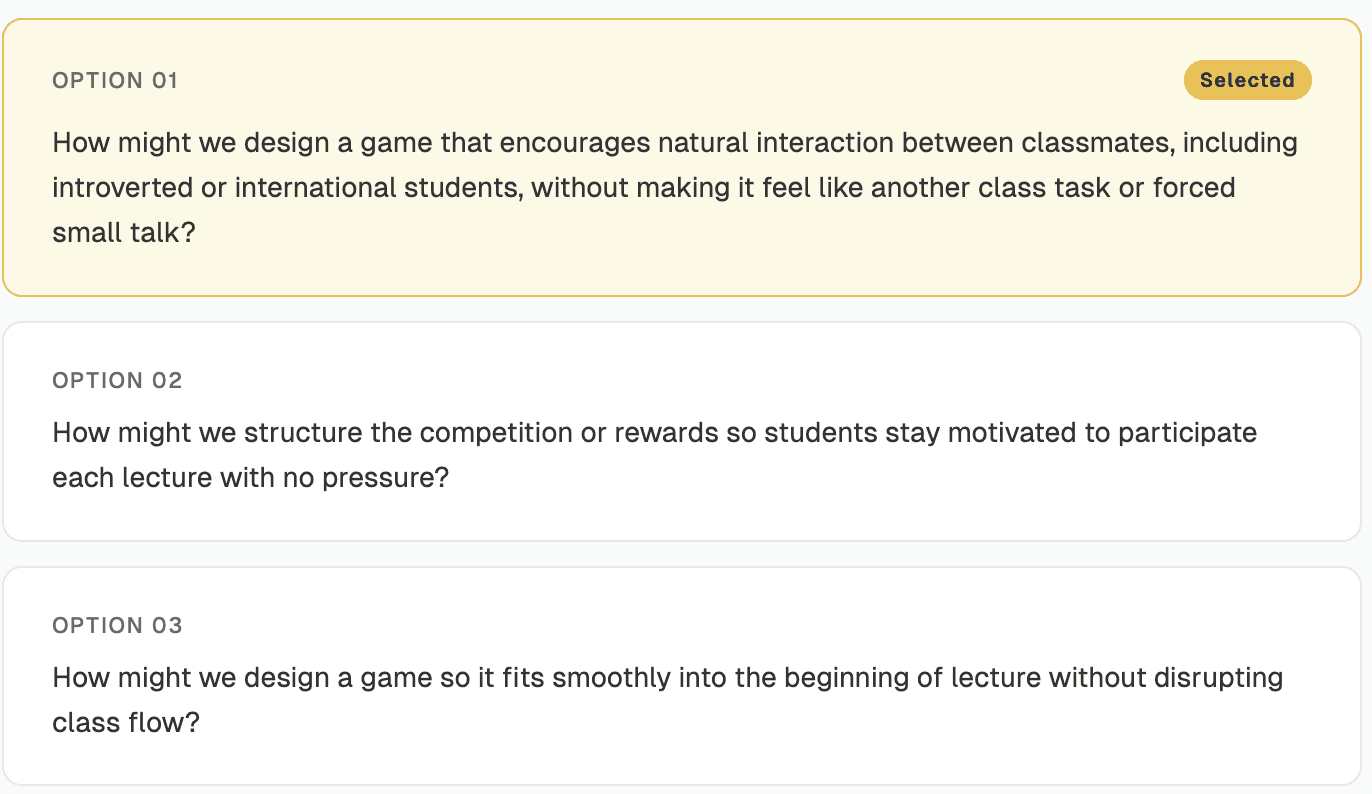
The selected question keeps the core goal of natural interaction while setting a clear constraint: it shouldn't feel forced. That constraint shaped every design decision that followed.
IDEATION
Three Concepts, One Direction

Lecture League was the strongest choice because it creates stable recurring encounters, not a one-time interaction or a seatmate lottery. The other two concepts restart the connection each class. Lecture League accumulates it.
REVISION
What I Changed, and Why
This is a revised version of the original project submitted in January 2026. Based on instructor feedback, four things were reconsidered.

SOLUTION
The System, in Three Parts
01. The Token
On the first day of class, every student receives a colored token from the TA at the entrance: yellow, blue, red, or green. In a class of 100, that's roughly 25 students per color.
The token does one thing: give you a reason to look around the room. Instead of 100 strangers, there are now 24 people who share something with you. When you spot the same color on someone's desk, you have a reason to sit next to them.

02. The Activity
In the last 2 minutes of each lecture, a prompt appears on screen. Students work with whoever from their color team is sitting nearby. No minimum group size, no formal rules. One person types, everyone else shouts answers. Responses are submitted individually to Canvas.
The activity takes 2 minutes. It's not a graded assignment. The prompt is intentionally low-stakes: something anyone can answer without preparation or fluency. The goal isn't performance. It's conversation.

WHAT STUDENT SEE ON SCREEN

classroom welcome screen

Week 1 prompt screen
03. The Quarter Arc
The activity isn't the same every week. The prompt types shift intentionally to match how familiarity develops over a 10-week quarter.

04. The Reward
Points accumulate across the quarter. In weeks 1-4, teams score based on number of valid responses. Weeks 5–7 are unscored - participation over competition. Weeks 8–10, class votes for the most creative answers.
At the final lecture, the highest-scoring color team wins. Each member of that team who submitted on Canvas at least three times across the quarter receives a $20 UW Bookstore gift card.
STORYBOARD
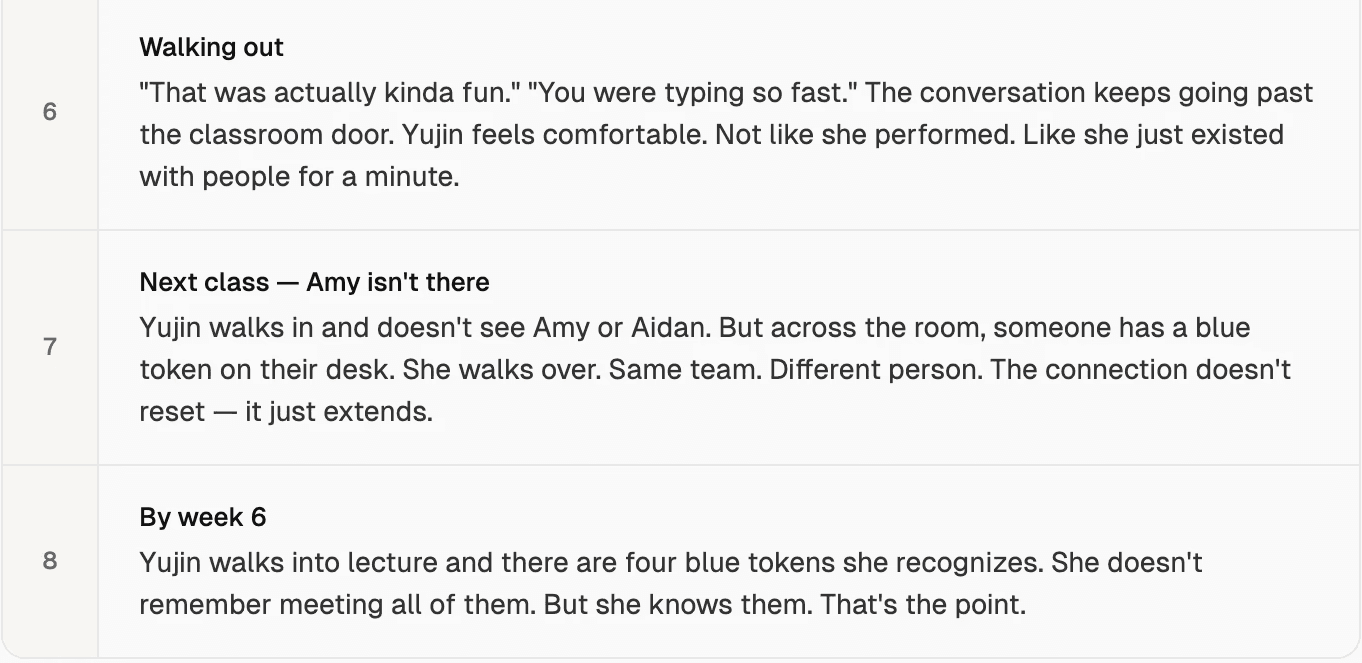
How It Plays Out for Yujin
Yujin is an introverted first-year student heading into her first DESIGN 166 lecture. She doesn't know anyone.

FEASIBILITY
Does it actually work - and can we afford it?

For a class of 100 students, one winning color team (~25 students) is eligible for the reward. Among those, only students who submitted on Canvas at least three times receive a $20 gift card. In practice this is likely 15-20 students, totaling $300-400. Colored tokens cost roughly $5 for 200 pieces. Total cost stays well under the $20 per student budget.
Everything else uses existing infrastructure: Canvas for submissions, the lecture screen for prompts. No new platform, no app, no equipment.

